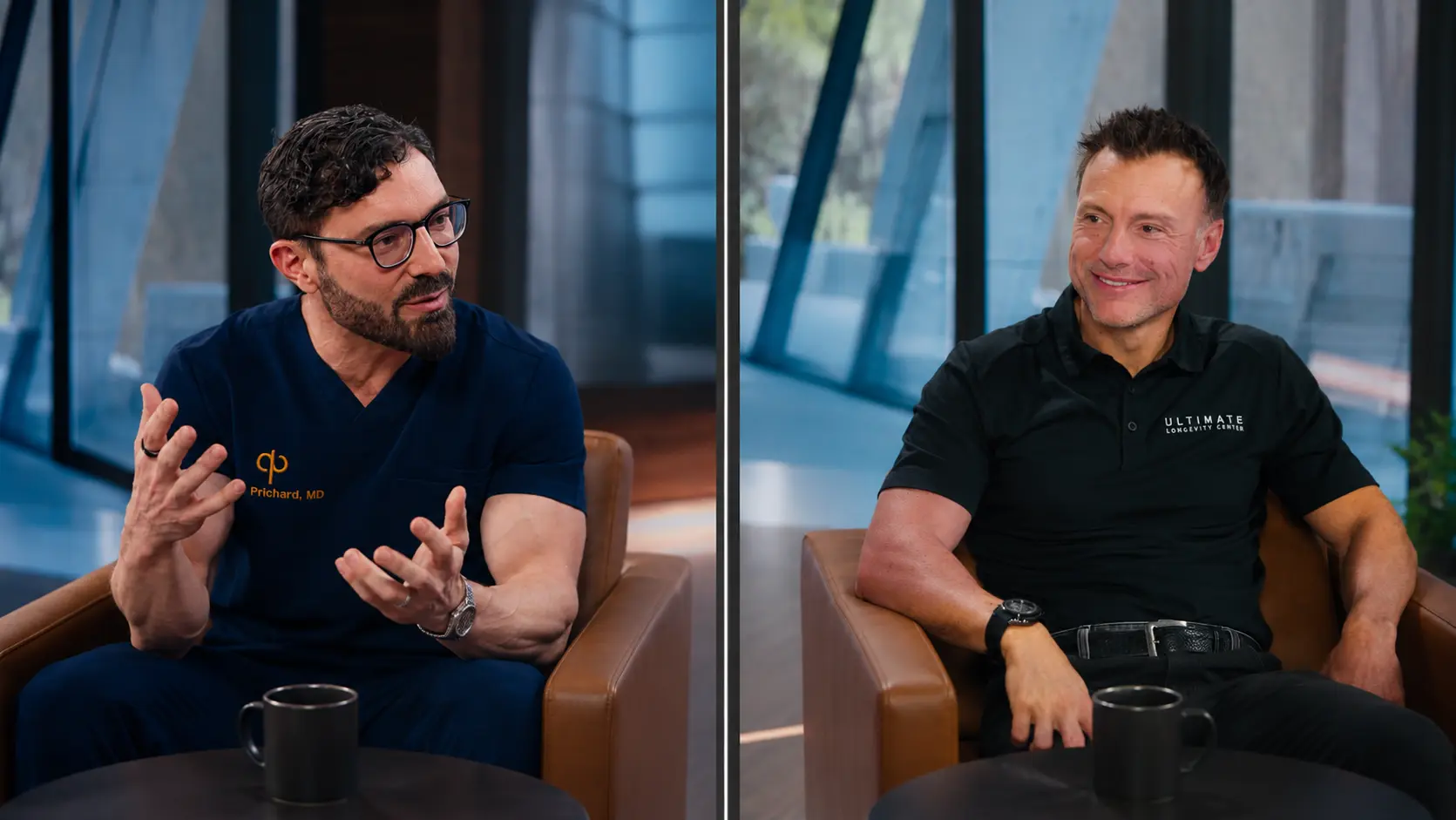
Johnjay Van Es makes a living on energy.
As a morning radio host, he turns oxygen into stories, jokes, timing, connection, and momentum before most people have even finished their coffee. His life is full: a wife, three sons, a radio audience, a dog rescue, a foundation supporting kids in foster care, and the daily pressure of being on.
But behind the humor is a serious question.
How long can the engine keep running?
This episode of Forever Young with Dr. Pablo Prichard explores one of the most powerful measures of performance, resilience, and longevity: VO₂ max, the body’s ability to absorb, deliver, and use oxygen at its highest limit.
For Johnjay, the test is personal. His father died of a heart attack at 66. His mother died of brain cancer at 66. That number has stayed with him, not as a statistic, but as a fear and a motivation. He wants to live past it. He wants to see his kids get married. He wants to see them have children of their own.
So Dr. Pablo brings him into the lab to answer a bigger question.
How strong is Johnjay’s oxygen engine, and how much younger could it become?
Oxygen Is Energy
VO₂ max can sound technical.
Volume of oxygen consumed. Maximum effort. Milliliters of oxygen per kilogram of body weight per minute.
But Dr. Pablo makes the science simple.
Oxygen consumption equals energy.
Energy equals life.
And the better the body uses oxygen, the better its cells can function. VO₂ max is not just a fitness number. It is a measurement of how well the lungs, heart, blood vessels, blood, muscles, and mitochondria work together when the body is pushed to its limit.
Every breath begins the relay.
Oxygen enters the lungs. Red blood cells pick it up. The heart pumps it through the body. Blood vessels deliver it to working tissues. Muscles and mitochondria use it to produce energy.
The real limiting factor is often the heart.
The lungs can usually take in more oxygen than the body can actually use. The heart determines how much oxygen-rich blood can reach the muscles under pressure. That is why cardio is not only about endurance. It is about the strength and efficiency of the entire delivery system.
A stronger oxygen engine does not only help someone move faster.
It helps the body adapt, recover, and endure.
Johnjay’s Reason to Change
Johnjay is honest about his history.
He once weighed over 300 pounds. In his 30s, he barely worked out. Cardio was hard, and even when he knew what he needed to do, he could talk himself out of it.
But grief changed the stakes.
Losing both parents at 66 made health feel less abstract. He began trying to do everything he could to stay around longer. Not just to avoid disease, but to remain present for the people who depend on him.
Dr. Pablo does not approach that fear with panic.
He approaches it with information.
He talks to Johnjay about genetic testing, family risk, cancer awareness, and proactive screening. He also points him toward something deeply practical and deeply powerful: cardio.
Johnjay’s reaction is familiar.
Cardio is hard.
But the episode keeps returning to the truth that many people already know and still struggle to accept: cardio may be one of the closest things we have to a “magic pill,” not because it is easy, but because it touches so many systems at once.
Testing the Engine
Dr. Pablo begins by breaking down Johnjay’s oxygen pipeline.
First, lung capacity.
Using an inspirometer, Johnjay tests how much air he can move. His lungs perform well, giving him room to spare.
Then Dr. Pablo checks his vitals, oxygen saturation, and heart function. An ultrasound gives a look at how the heart is moving. Johnjay is encouraged by what he sees. Some parts of the system are working well.
Then comes the VO₂ max test.
A mask measures how much oxygen Johnjay breathes in and how much oxygen he breathes out as he walks, runs, and pushes toward maximum effort. The test is uncomfortable, physical, and revealing. It turns the idea of cardiovascular capacity into data.
The result gives Johnjay something useful.
Not a judgment.
A baseline.
He can improve this number. And because VO₂ max reflects the performance of the whole oxygen system, improving it may help more than his workouts. It may support his energy, resilience, recovery, and long-term health.
The Three Eggs of Cardio
After the lab, Dr. Pablo takes Johnjay into the real world to show him how to train.
He gives the workouts a playful structure: eggs.
Over easy.
Over medium.
Hard boiled.
Over easy is a three-minute speed walk followed by a three-minute regular walk, repeated until hitting 30 minutes.
Over medium raises the intensity: a three-minute jog followed by a three-minute walk.
Hard boiled is the real test: 20 seconds of all-out sprinting followed by 10 seconds of walking, repeated eight times for a total of four minutes.
It is essentially a Tabata-style challenge, short but intense, designed to push the oxygen engine hard enough to force adaptation.
Johnjay feels it immediately.
The work is harder than expected. But it is also clarifying. He leaves with tools, not just theory. He understands that VO₂ max training does not require mystery. It requires choosing the level that matches where he is now, then showing up consistently.
The hard part is not knowing what to do.
It is doing it long enough for the body to change.
What the Wheel of Age Reveals
As Dr. Pablo reviews Johnjay’s labs, one signal stands out.
His cardiac age is the major factor holding him back.
There are good signs elsewhere. His metabolic markers are strong. His inflammation looks good. His Cancerguard test comes back negative. But the cardiovascular piece is where the biggest opportunity lives.
Then Johnjay steps onto the Wheel of Age.
The result confirms what Dr. Pablo has been building toward: VO₂ max is not a side issue for him. It is the place where change could make the biggest difference.
Johnjay feels the truth of it.
Mentally, he still feels 25. But the reflection in the mirror and the numbers on the Wheel tell him that his body is asking for attention in a specific way.
Dr. Pablo’s message is hopeful.
Cardiac age can improve.
Dramatically.
That matters to Johnjay not only for himself, but for his family. He wants his kids to see the lesson early, while their choices can shape decades of health ahead.
Three Exact Science Tips
Dr. Pablo closes with three clear takeaways for building the aerobic engine.
VO₂ max is a vital sign of youth.
It is not just for athletes. It reflects how well the heart, lungs, blood vessels, and mitochondria work together. The higher the capacity, the more resilient the body can become from the inside out.
You do not need extremes. You need consistency.
Pick the level that fits where you are now: over easy, over medium, or hard boiled. Thirty minutes, three times a week, can help move the body in the right direction.
Recovery is part of the training.
VO₂ max improves when stress is followed by recovery. Stretching, sleep, hydration, and even sauna can help the heart, blood vessels, and mitochondria adapt and grow stronger.
The point is not to destroy the body.
The point is to challenge it, then let it rebuild.
What This Episode Leaves You With
Your aerobic engine powers more than exercise.
It powers how you move through life. How you recover. How you handle stress. How your brain, muscles, immune system, and mitochondria receive the oxygen they need to keep going.
Johnjay’s story makes VO₂ max personal. It is not about chasing an athletic score. It is about wanting more years with the people you love. It is about turning family history into action. It is about discovering that one of the most powerful levers for longevity may be trainable, measurable, and closer than we think.
The breath becomes fuel.
The heart becomes the delivery system.
The mitochondria turn effort into energy.
And the engine can be trained.
Watch this episode of Forever Young with Dr. Pablo Prichard on NBC to see how Johnjay Van Es puts his oxygen engine to the test, why VO₂ max may be one of the strongest predictors of resilience and longevity, and how training your breath, heart, and muscles can help you stay younger, one breath at a time.